Best Vitamins for Perimenopause Fatigue: Test First, Then Buy

Paid link disclosure: we may earn a commission, at no extra cost to you. How we choose recommendations.

There is no single best vitamin for perimenopause fatigue. The four things most often behind new tiredness in your forties — ferritin (iron stores), vitamin B12, vitamin D and thyroid function — are ordinary blood tests, not shelf decisions, and iron is the one clinicians generally want confirmed first. Of what is reasonable to add while you wait, magnesium glycinate is where we would start.
Search this and you get a wall of bottles. The nutrients with the clearest link to tiredness in your forties are the ones you cannot judge from a shelf: perimenopause commonly brings heavier bleeding, a documented route to low iron stores; B12 absorption falls with age and with drugs many women here already take, including metformin and long-term acid reducers; and hypothyroidism shares nearly every symptom on the perimenopause list. All four are one blood draw. Below is what is reasonable to add while you wait on those results — ranked, with the two we would not buy labeled.
Reviewed July 2026 · compiled from published human research, clinical practice guidance and manufacturer label data — we do not personally test products · educational only, not medical advice. Talk to your clinician before adding a supplement, especially alongside prescriptions.
Our top picks at a glance
| # | Supplement | Rating | Price | |
|---|---|---|---|---|
| #1 |
Magnesium glycinate
Best Overall to Add Without a Blood Test
|
★★★★★ 4.5/5 | See current price | Check price → |
| #2 |
CoQ10 (ubiquinol form)
Best Vitamin-Like Pick for the 3 p.m. Wall
|
★★★★★ 4.4/5 | See current price | Check price → |
| #3 |
Omega-3 (EPA/DHA fish oil)
Best If Brain Fog Rides Along With the Tiredness
|
★★★★★ 4.2/5 | See current price | Check price → |
| #4 |
Iron, taken without a ferritin test
What We Would Skip
|
★★★★★ 1.5/5 | Varies by brand | See review ↓ |
| #5 |
Mega-dose B12 shots and “energy” B-complex gummies
What We Would Skip
|
★★★★★ 1.8/5 | Varies by brand | See review ↓ |
Magnesium glycinate
Not technically a vitamin — but the aisle staple most likely to be filling a gap that is actually there.
Paid link · affiliate disclosure
Magnesium glycinate
Not technically a vitamin — but the aisle staple most likely to be filling a gap that is actually there.
Magnesium is a mineral, not a vitamin, and it takes the top slot here for an honest reason: US national dietary-intake survey data through the 2010s has repeatedly found a large share of adults taking in less than the estimated average requirement, so the shortfall is common rather than theoretical. Magnesium is a cofactor in the enzyme reactions cells use to produce and spend energy, and unlike iron or B12 it does not need a lab result to justify a modest daily amount. The glycinate form is the one chosen for tolerability — magnesium oxide is the cheapest and the most associated with loose stools. It supports normal muscle and nervous-system function; it does not treat perimenopause or cure fatigue. (Doctor’s Best High Absorption Magnesium Glycinate is a widely stocked chelated option.)
What we like
- Dietary shortfall is common in US adults, so a gap is likely rather than hypothetical
- No blood test needed to justify a modest daily amount
- Glycinate is the form chosen for GI tolerability over cheap oxide
- The least expensive item on this list
Tradeoffs
- A mineral, not a vitamin — it will not fix a B12, D or iron problem
- Serum magnesium poorly reflects body stores, so you cannot easily confirm a gap either way
- Can loosen stools; needs spacing from some antibiotics and thyroid medication
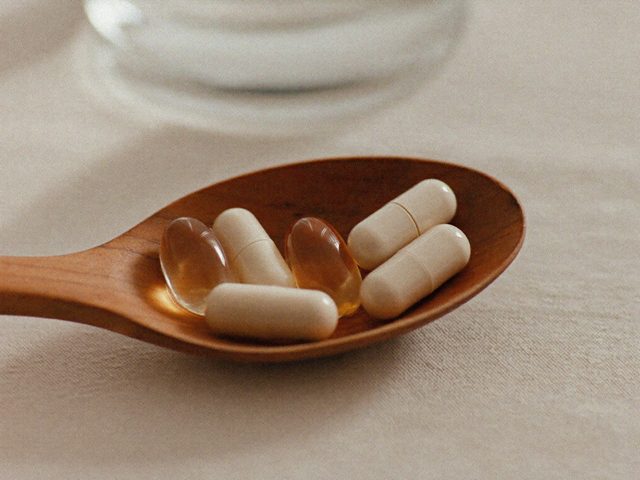
CoQ10 (ubiquinol form)
Sits in the vitamin aisle without being a vitamin — and carries the most adult-trial data of anything here.
CoQ10 is classed as a vitamin-like compound: fat-soluble, made in the body, and used as an electron carrier in the mitochondrial chain that produces ATP. Ubiquinol is its reduced form, which research suggests adults over 40 absorb more readily than the oxidized ubiquinone most cheap bottles contain. The adult trials that report improvements in subjective energy and exercise tolerance run roughly 8 to 12 weeks, so this is not a same-week decision — if you try it, give it the full window before judging. It supports cellular energy production; it does not treat or cure perimenopause. (NOW Ubiquinol 100 mg is a standardized, widely stocked option.)
What we like
- The most consistent adult-trial record of any single mitochondrial cofactor
- Ubiquinol is the better-absorbed form in adults over 40
- One ingredient, so you can actually evaluate it on its own
Tradeoffs
- Not a vitamin — it will not correct a nutrient deficiency
- The most expensive item here per month
- Works on an 8-to-12-week timeline, not days
- Known interaction with warfarin — a conversation to have with your prescriber first
Omega-3 (EPA/DHA fish oil)
Also not a vitamin. Included because fog and fatigue almost never arrive separately.
EPA and DHA are fatty acids, not vitamins, and there is no honest claim to make that fish oil fixes fatigue. It earns a place here for a narrower reason: the women searching this rarely have tiredness alone, and DHA is a structural component of neuronal membranes, which is why the omega-3 literature clusters around cognition and mood rather than energy. If the flat, word-finding, cannot-hold-a-thread feeling is riding along with the tiredness, this is the more matched buy. Look for a bottle that states EPA and DHA amounts on the front and carries third-party purity testing — “1000 mg fish oil” on a label tells you the capsule weight, not the active dose. (Nordic Naturals Ultimate Omega is a third-party-tested option.)
What we like
- Third-party-tested options are easy to find, which is not true across this aisle
- Matched to the fog half of the complaint rather than sold as an energy fix
- Front-label EPA/DHA amounts make the real dose checkable
Tradeoffs
- No fatigue claim to make — it is the wrong target if tiredness is the only symptom
- Fishy burps are the usual complaint; cheap oxidized oil is the usual cause
- Relevant to anyone on blood thinners — raise it with your prescriber
Iron, taken without a ferritin test
The most commonly guessed-at fix on this list, and the one with a real reason not to guess.
Low iron is a genuinely common driver of fatigue in perimenopause, precisely because cycles often get heavier before they stop. That is the argument for testing ferritin, not for buying iron on a hunch. The body has no efficient route to excrete excess iron, which is why supplementing it without a documented shortfall is discouraged and why hemochromatosis is screened for at all. Guessing also hides the question that matters: heavy bleeding worth investigating, or a gut absorption problem, both of which a bottle papers over. Ask for ferritin, not just hemoglobin — iron stores can be depleted well before a standard anemia screen turns abnormal.
What we like
- The underlying problem is real and common in perimenopause
- Cheap and easy to get — which is exactly why it gets guessed at
Tradeoffs
- There is no efficient way for the body to shed excess iron
- Constipation and nausea are common enough to end most unsupervised attempts
- Masks the cause — heavy bleeding or malabsorption both need a look
- A ferritin test costs less than a year of guessing
Mega-dose B12 shots and “energy” B-complex gummies
Bright yellow urine is not a mechanism. If B12 is low, that is a finding; if it is not, more is not better.
B12 belongs in this conversation — absorption declines with age and with metformin and long-term acid reducers, and deficiency does present as fatigue. What does not follow is the 5,000%-of-RDA shot or the gummy sold on the promise of a lift. B vitamins are water-soluble, so once the requirement is met the surplus is largely excreted, which is where the fluorescent-yellow urine comes from. If your B12 is genuinely low that is a diagnosis with a follow-up question attached — diet, absorption, or medication — and it is worth answering rather than out-dosing. Test it, then treat what the number says.
What we like
- The underlying nutrient genuinely matters, and a real deficiency is worth finding
Tradeoffs
- Mega-doses do not produce a lift in people who are not deficient
- Gummies typically carry added sugar and less of what is on the front of the jar
- Skips the question a low result should trigger: why is it low
- High-dose B6 in some “energy” complexes carries a known nerve risk over time
How we picked these
We compared the supplements women in their 40s are actively buying for perimenopause fatigue against the human-trial research. Three filters: (1) at least one peer-reviewed adult-population study at the dose the product uses, (2) standardized extracts and disclosed actives (not proprietary blends), and (3) a sustainable daily ritual format — because the literature uses 4-to-12-week windows and a supplement you cannot stick with for two months is useless.
We do not personally test products. We earn affiliate commissions on some of the links above; the picks are based on the literature, not on commission size. Our full disclosure page covers how we choose what to recommend.
Side-by-side comparison
| Supplement | Best for | Our rating | Price | |
|---|---|---|---|---|
| Magnesium glycinate | Best Overall to Add Without a Blood Test | ★★★★★ 4.5/5 | See current price | Check price → |
| CoQ10 (ubiquinol form) | Best Vitamin-Like Pick for the 3 p.m. Wall | ★★★★★ 4.4/5 | See current price | Check price → |
| Omega-3 (EPA/DHA fish oil) | Best If Brain Fog Rides Along With the Tiredness | ★★★★★ 4.2/5 | See current price | Check price → |
| Iron, taken without a ferritin test | What We Would Skip | ★★★★★ 1.5/5 | Varies by brand | Not recommended |
| Mega-dose B12 shots and “energy” B-complex gummies | What We Would Skip | ★★★★★ 1.8/5 | Varies by brand | Not recommended |
Frequently asked
Which blood tests should I ask for?
The panel clinicians commonly reach for when a woman in her forties reports new fatigue is ferritin (iron stores, not just hemoglobin), vitamin B12, 25-hydroxy vitamin D, and thyroid function via TSH. A complete blood count usually comes along with it. Ask for the actual numbers rather than “normal” — ferritin in particular can sit at the very bottom of a reference range while your iron stores are functionally depleted, and that is a conversation worth having with the number in front of you.
Why not just take iron? Heavy periods are the obvious cause.
Because the body has no efficient route to excrete iron, and because heavy bleeding in perimenopause is itself worth a look rather than a workaround. Testing ferritin costs less than a year of guessing and turns the question into a specific one. If the result is low, the follow-up is what is driving it — bleeding volume, absorption, diet — and that answer changes what actually helps.
Everyone says to take vitamin D. Should I?
Vitamin D insufficiency is common enough that many clinicians will test 25-hydroxy vitamin D as part of a fatigue workup, and the useful thing is knowing your level. It is fat-soluble, meaning it accumulates rather than flushing like the B vitamins, so it is one where the number matters more than the habit. This is a conversation to have with the result in hand rather than a shelf decision.
My bloodwork came back completely normal. Now what?
That is the most common starting point for this whole category — ferritin, B12, D and thyroid all in range, and the wall still hits at 3 p.m. At that point the question moves from nutrient gaps to the cellular-energy side, which is a different short list. Our supplement comparison for perimenopause fatigue covers what the research supports there, and the afternoon-crash breakdown covers the glycemic and cortisol pattern behind the specific 3 p.m. version.
Are menopause multivitamins worth it?
The recurring problem is the proprietary blend. When a label lists eight botanicals under one combined milligram figure, there is no way to know whether any single ingredient is present at the amount the research used, and no way to tell which one is responsible if something changes. A multivitamin at ordinary RDA levels is a reasonable nutritional floor; a menopause-branded blend at a four-times markup is usually paying for the word on the front.
Do I take all of these at once?
Pick one and hold everything else steady. Starting three things in the same week means that if anything shifts you will not know which one did it, and if nothing shifts you will not know what to drop. The adult trials behind the picks above run four to twelve weeks, so give one item that window, write a 1-to-5 afternoon-energy rating a few times a week, and reassess with notes rather than memory.
Not sure which one is for you?
Take the 2-minute perimenopause type quiz
Map your top 3 symptoms to the supplement category most likely to help. Free, no email required to start.
Start the quiz →